DISCOVER
In winter, Messinia’s medieval castles take on a quiet, contemplative charm, with low sunlight and crisp air picking out every stone, chapel, and tower in the serene magic of the season.
Edited by Paulina Björk Kapsalis
Messinia’s medieval sites form a garland of stone landmarks that once guarded sea routes, controlled trade, and shaped the cultural life of the Peloponnese. They’re impressive at any time of year, but in winter – when the air sharpens and the crowds thin – the castles, monasteries, and fortified towns reveal a more intimate kind of magic. Stone corridors seem to echo with the stories they once held, and local traditions rooted in medieval customs come alive through winter feasts, saints’ days, and quiet village rituals. This is a landscape shaped by Byzantines, Franks, Venetian, and Ottoman forces, yet softened by myth, memory, and the rhythms of the season.
Whether you explore a single castle or take on the full circuit, these sites create a journey through time that feels both grounded and slightly enchanted. From coastal giants to half-ruined hilltop keeps, these are Messinia’s most compelling medieval encounters:
Methoni Castle
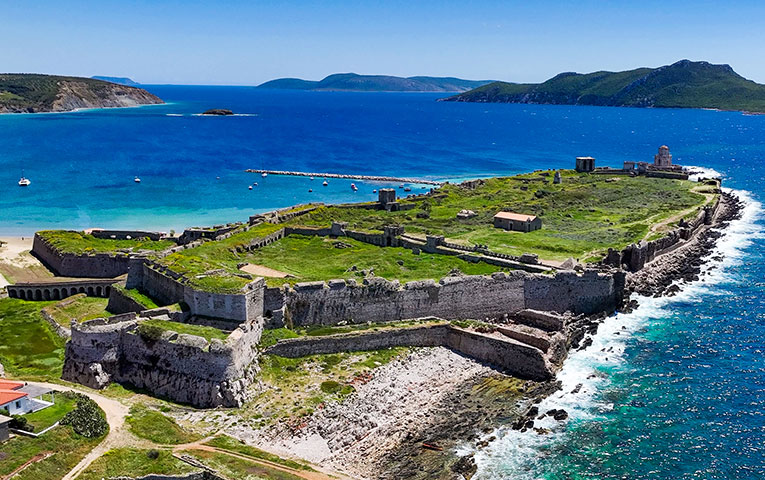
Methoni Castle occupies one of the most commanding positions in the Peloponnese — a fortified cape projecting into the sea, protected by massive ramparts and a wide moat. When the Venetians took control in the 13th century, they immediately recognized Methoni as a key link in their maritime empire. It became a vital staging point for ships sailing between Venice and the Levant, and its fortifications were repeatedly reinforced to match its strategic importance.
The central gate, adorned with the winged lion of Saint Mark, remains one of the most photographed medieval symbols in Greece. Beyond it lie the remains of storehouses, officials’ quarters, and traces of a once-bustling port community shielded behind the walls. In winter, low sunlight striking the stone creates a sense of gentle solemnity, and it’s easy to imagine Venetian sailors celebrating Christmas or New Year’s Mass quietly in the small chapel within the fortress.
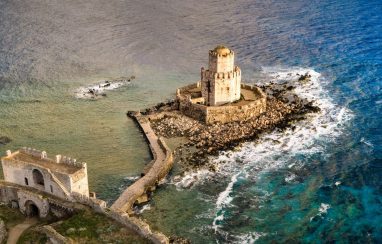
Among the castle’s most striking features is the Bourtzi, the octagonal sea tower built shortly before and in the early 1500s. Originally designed as a lookout, it later served darker purposes: in Ottoman times, it became a prison and a site of executions. This dual nature is what lingers most vividly – elegant Venetian architecture layered atop the hard realities of military life.
Koroni Castle
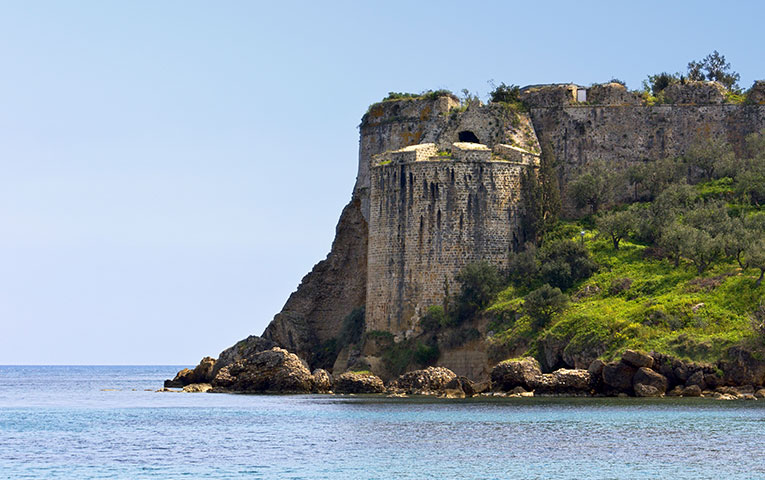
Koroni Castle shares Methoni’s Venetian past but has a distinct character shaped by its dramatic topography. Built on a steep promontory above the town, it was one of the strongest fortifications in the southern Peloponnese – paired with Methoni as a twin defensive point guarding vital sea routes. The Venetians considered the two castles “the eyes of the Republic,” watchpoints that safeguarded their trade networks across the eastern Mediterranean.
Several architectural phases remain visible: late Byzantine foundations, Venetian curtain walls, Ottoman gates, and domestic structures that once housed officials, soldiers, and craftsmen. One of the most evocative layers is the 13th–14th-century period, when Koroni served as both a military outpost and a religious center, evidenced by the cluster of chapels within the enclosure.
In the quieter winter months, you can almost feel the echo of saints’ day celebrations, when candles would have been lit for Saint Nicholas or when Christmas processions moved through the precinct. Walking through its gates, with the sea wind rising against the ramparts, you sense centuries of intertwined histories – Venetian merchants, Ottoman governors, monastic voices – all carried across the stone passages in a murmur of winter festivals long past.
Paleokastro
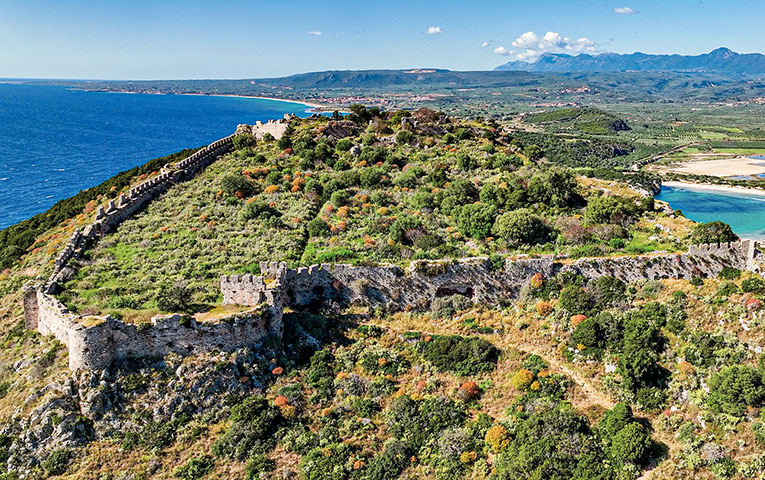
A short hike from Cοsta Navarino, on the craggy headland above Voidokilia Beach, lie the remains of the old fortress of Navarino, known as Paleokastro (“old castle”). Though weathered and partly collapsed, its position is so commanding that its strategic value becomes instantly clear. Built by the Franks in the 13th century and later enhanced by Venetians and Ottomans, the fortress controlled the northern entrance to the Bay of Navarino, one of the safest natural harbors in the Peloponnese.
Old Navarino’s walls tell a complex geopolitical story. Like the other castles, the site changed hands repeatedly, reflecting the broader contest between Latin crusader states, Byzantines, Venetians, and the expanding Ottoman Empire. Even in its ruined state, you can distinguish sections of different periods: the Frankish core, later Venetian reinforcements, and Ottoman adaptations. Its proximity to the site of the 1827 Battle of Navarino adds yet another layer; although the fortress was obsolete by then, the bay it once guarded played a decisive role in the Greek War of Independence.
The climb to the fortress is rugged, but on clear winter days the reward is incomparable: sweeping views over the bay, the Gialova lagoon, and the flawless circle of Voidokilia Beach.
Neokastro
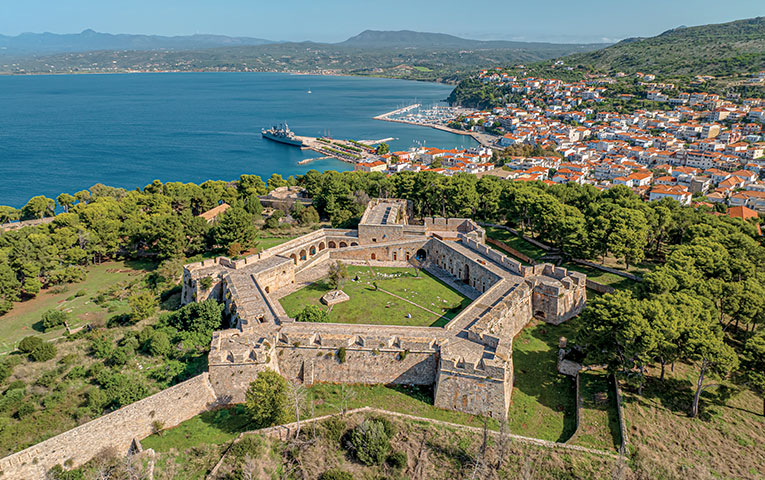
After suffering heavy losses at the Battle of Lepanto (1571), the Ottomans built a new castle to replace Paleokastro in 1573. Neokastro (“new castle”) was more advanced and better equipped than its predecessor, and today it stands as one of the most complete early modern fortresses in Greece. Though slightly later than classical “medieval,” it is central to Messinia’s fortified history and tied directly to the Venetian–Ottoman conflicts of the late Middle Ages.
The fortress’s hexagonal layout, low thick bastions, and sea-facing walls illustrate the evolution of military architecture in the gunpowder age. The imposing citadel at the top, with its sweeping views toward Sfaktiria Island, served as the Ottomans’ command center, later occupied by French, Egyptian, and Greek forces.
Today, Neokastro houses the Archeological Museum of Pylos, which showcases finds from across the region, including relics from underwater sites such as the Battle of Navarino.
Photo credits: Nikos Tsiakalakis
Androusa Castle
Often overlooked by visitors, Androusa Castle was once one of the most important Frankish administrative centers in the Peloponnese. Built in the 13th century under the Villehardouin dynasty, it served as the seat of the princely bailiff, overseeing fertile plains that supplied grain, olives, and wine to the Principality of Achaea. Its inland position, rather than a coastal one, made it strategically valuable as a control point over the region’s agricultural wealth.
The castle’s rectangular layout and robust towers reflect classic Frankish military design. Though partially ruined, the surviving gateway and stretches of curtain wall still convey the sense of an organized medieval complex rather than a simple fortress. The Venetians later repaired parts of it, recognizing Androusa’s continued economic importance.
While not historically documented, local tradition holds that Princess Isabella of Villehardouin stayed here during periods of political turmoil. Her life, marked by contested marriages and shifting allegiances, became entangled with the destiny of Messinia itself. Stories persist of secret negotiations held within Androusa’s halls and emissaries slipping out under cover of night to broker alliances.
Kalamata Castle
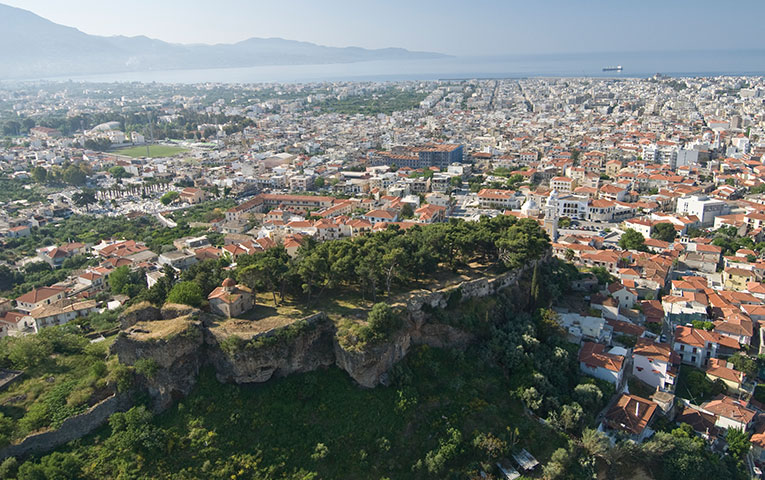
Today, the grounds of Kalamata Castle grounds have been repurposed as a public park, complete with a small amphitheater and spaces for cultural events. However, in soft winter light at dawn or dusk, the panoramic views over modern Kalamata alone are reason enough for a visit, not to mention the history contained in the sprawling ruins.
Perched on the rocky spur that once served as the acropolis of ancient Pharae, Kalamata Castle is another great monument to centuries of shifting rule and layered architecture. The site was fortified in Byzantine times; however, the castle that dominates the hill today mostly dates to the early 13th century, when, under the Frankish Principality of Achaea, – especially the Villehardouin family – it was remodeled and elevated into the seat of the Barony of Kalamata.
Over the centuries, the fortress passed through Byzantine, Frankish, Venetian, and Ottoman hands, and each era left its mark: expansions, repairs, a gatehouse bearing the emblem of the Lion of Saint Mark from the Venetian period, and later neglect and partial destruction during the Ottoman-Venetian wars and the Greek War of Independence. While much of it is ruined today, the medieval plan is still legible: a fortified upper ward (inner bailey) with a tower-keep on the hill’s highest point, and a lower outer enclosure protecting the more vulnerable slopes.
Kyparissia Castle
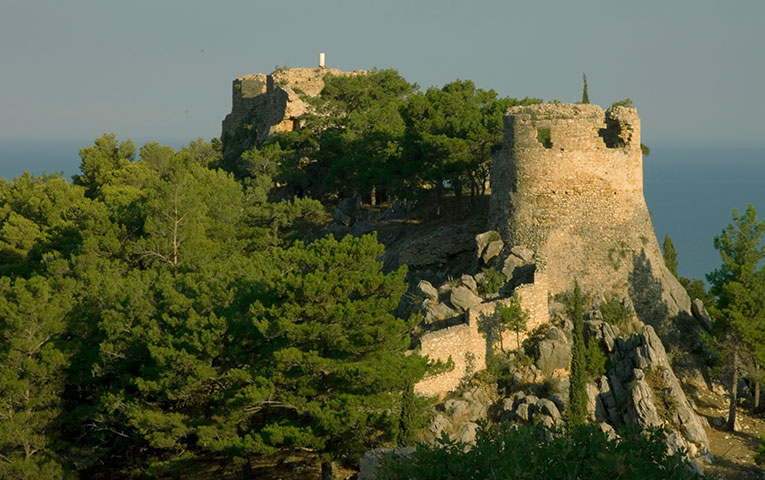
Kyparissia’s medieval castle, also known as the Castle of Arcadia after the town’s Venetian name, crowns a steep hill overlooking the sandy coastline. The site has been used since antiquity, with the medieval fortress built atop the ancient acropolis. The surviving structures date mainly to the Byzantine period, later reinforced by the Franks during the Principality of Achaea. The upper citadel forms a compact defensive core, while its elevated position allowed control of the surrounding plains and access to the port below.
In winter, the castle is quiet and the light softer, giving the ruins a calm, reflective atmosphere. Visitors might find themselves completely alone to explore the remains of towers and walls, while the hilltop offers clear views of the coastline and surrounding landscape. The structures convey a tangible sense of continuity from ancient acropolis to Byzantine stronghold to Frankish fortress, making the site a beautifully serene destination in the off-season.
Zarnata Castle
Rising above the plain of Kampos and the valley north of Mani, Zarnata Castle occupies a modest hill between the villages of Kampos and Stavropigio. Its defenses — a circuit wall with circular and rectangular towers — partly rest on the foundations of an ancient citadel (possibly ancient Gerenia), pointing to a long history of strategic occupation here from antiquity through the early modern period.
Most of the visible fortress dates to mid-17th-century Ottoman rebuilding, after earlier fortifications had deteriorated or been destroyed. Within the enclosure, remnants of a post-Byzantine and Ottoman-era settlement survive, including an old church of Saint Nicholas, a later church of Zoodochos Pigi (1776), cisterns, tower-residences, and ruined watchtowers.
Mystras
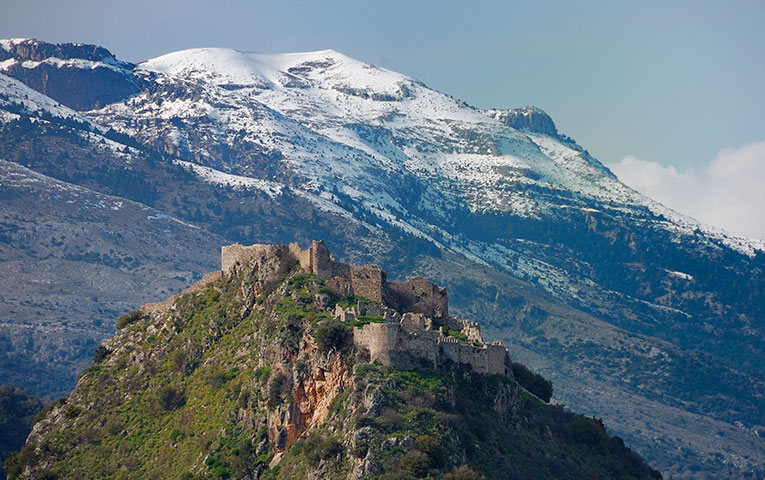
Not technically in Messinia but close enough to be a natural extension of this journey, Mystras is the pinnacle of medieval Greek heritage: a whole Byzantine city preserved across a mountainside. Palaces, monasteries, frescoed churches, mansions, cobbled streets — everything whispering of Byzantium’s final flourish before its fall in 1460.
In winter, with the tourist crowds thinned, walking through Mystras allows visitors to connect with the ritual life of the Byzantine city, imagining the medieval inhabitants celebrating holy days against the backdrop of fortified terraces and cold mountain winds. Less a single site and more of a time capsule, Mystras is the perfect grand finale to a medieval-themed itinerary that now also captures a hint of winter magic and the living traditions rooted in medieval Peloponnese.