EMBRACE
‘Tis the season when goblins climb through chimneys, fountains are “fed” at midnight, and gifts arrive at New Year’s. These are the holiday tales you never knew existed.
By Paulina Björk Kapsalis
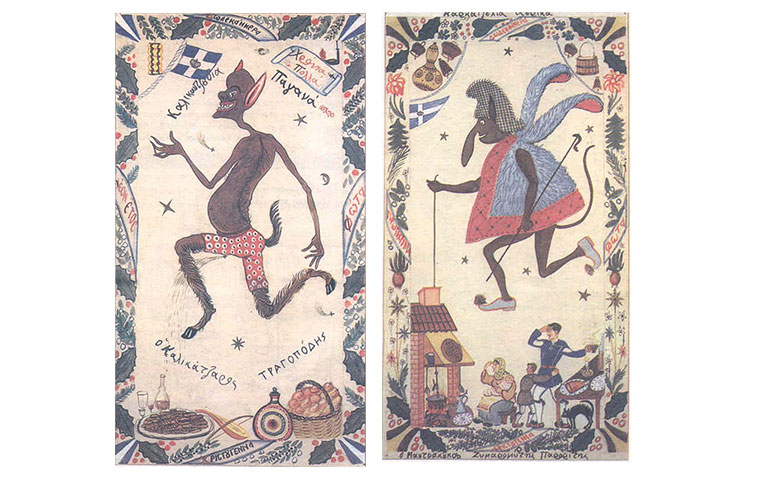
Families today often stage the Elf on the Shelf as a merry prankster who scatters flour across the kitchen floor, turns furniture upside down, or hangs from the ceiling lamp. Children wake with delight and suspense, wondering: what prank has the Elf orchestrated this time? But did you know that Greece has its own seasonal mischief-makers, far older and far wilder: the kallikantzaroi, Christmas goblins whose antics have been whispered about for centuries. Appearing where you least expect them — like in the tiny villages of Messinia at midnight — what makes them truly enthralling is that, unlike the staged pranks of a modern elf, the kallikantzaroi were once feared. So, who are these scary holiday visitors?
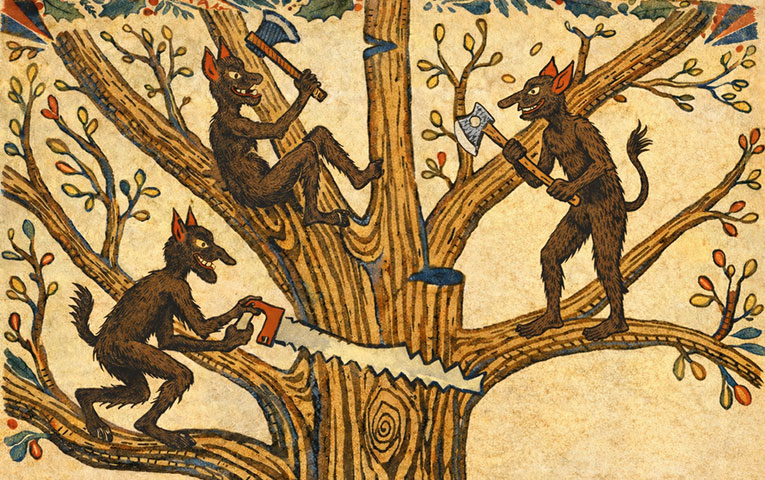
Their appearance varies across regions and storytellers. Sometimes, they’re described as ugly, devil-like goblins with long black tails. Other times, they have goat- or donkey-like feet, pointed ears, and exaggerated male features, resembling the trickster god Pan or the comically hideous satyrs of ancient Greek mythology. Either way, according to Greek folklore, these naughty creatures spend most of the year underground, sawing away at the World Tree — a cosmic tree that supports the Earth itself. By weakening it, the goblins threaten the balance of the world. Their efforts are doomed, however, as they must emerge above ground during the Twelve Days of Christmas (December 25 to Epiphany, January 6), and the tree heals itself in their absence.
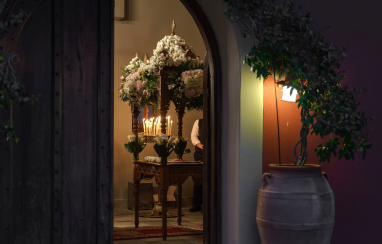
Once above ground, the goblins sneak into homes, slipping down chimneys, squeezing through cracks, or crawling under doors. Inside, they create mischief wherever they go: overturning furniture, soiling the hearth, ruining food, eating the Christmas pork, and generally spreading chaos throughout the household. To protect themselves, families in the past followed a series of ritualized precautions: keeping fires burning continuously through the night, hanging garlic or placing a colander outside the door (the goblins, unable to count past two — as three is a holy number — would waste hours trying to tally its holes), or sprinkling holy water to drive them away. Even in the comparatively warm climate of Messinia, stone houses would glow with the light of hearth fires, providing both warmth and a safeguard against these nightly visitors.
Folklore Meets Faith
The World Tree casts a cosmic shadow over these tales, its branches and roots connecting heaven, earth, and the underworld. Each year, the goblins’ frantic sawing weakens its trunk, explaining why, during the Twelve Days of Christmas, order falters and chaos briefly reigns. Though born from pre-Christian myth, these stories gradually merged with the Christian calendar, weaving a tapestry of old and new beliefs. Many tales were told simply to amuse, yet others carried quiet moral weight: lessons against greed, carelessness, or the folly of losing one’s wits in the long winter nights. Today, it’s even tempting to see a symbolic echo in the cutting of Christmas trees — a reminder to consider the impact of how many we fell.
Lessons of Winter Tales
One popular story with a moral lesson is that of Kallo and Marbo. Kallo was beautiful; Marbo was envious. One day, Marbo sent Kallo to the mill to grind flour late at night. As she waited for her turn, the goblins appeared and threatened to eat her. Quick-witted, Kallo told them she could not be eaten in her old dress and demanded a new one. When they brought her a fine dress, she cleverly asked for more: a coat, an umbrella, a comb, face powder, and anything else she could think of, keeping the goblins occupied until dawn. By the time the first light appeared, the goblins had to leave, and Kallo returned home with her grain and gifts. Jealous, Marbo tried the same task, but the goblins saw through her and scratched her face with their sharp claws.
A local variant in Messinia, recorded from the mountain village of Megali Mantineia, tells of an old man who manages to outwit the goblins inside a cave, keeping them occupied around roasted meat until he can escape. A bit further north, in an old village near Kalamata, a woman passing through the Sola hollow one night during the Twelve Days witnessed kallikantzaroi dancing on a threshing floor and escaped only by dancing among them until dawn.
Saint Basil, Bringer of Gifts
Greece having its own goblin lore is one thing, but did you know it also has its own Santa? And just as the kallikantzaroi tales blend ancient folk beliefs with Christian traditions, so too does the figure of Aghios Vasilis, or Saint Basil. While the familiar red-suited Santa appears in shop windows and festive displays, the Greek bringer of gifts is not jolly Saint Nick at all, but a completely different saint rooted in early Christianity.
A 4th-century bishop and one of the Three Hierarchs of the Eastern Orthodox Church, Basil the Great — a.k.a. Basil of Caesarea — was known for caring for the poor, establishing hospitals, and dedicating his family’s wealth to those in need. Greek traditions have embraced much of the common Santa mythology (flying reindeer, toy-making elves, and a North Pole home), yet the essence of gift-giving remains firmly rooted in this historical figure. It is said that Aghios Vasilis once found himself in possession of many valuables belonging to the citizens of Caesarea, with no way of knowing what belonged to whom (tellings differ as to why they were collected). As a solution, he had them all baked into buns and handed them out to the people. Today, on his feast day on January 1st, his act is echoed by the cutting of the Vasilopita — a cake containing a lucky coin — and by the giving of gifts.
Feeding the Fountain
Across parts of Central Greece, another winter ritual used to unfold quietly at midnight: the tradition known as “feeding the fountain.” On Christmas Eve or New Year’s Eve, young women would walk to the village spring to collect the first, untouched “silent water” of the night, believed to hold special power for the year ahead. Before drawing it, they would “feed” the fountain with offerings, smearing its stones with butter or honey, or leaving small gifts of bread, cheese, or legumes, to invite sweetness, fertility, and prosperity into the household. Some storytellers imagine these gifts left for supernatural beings such as the Fates, while others describe the custom simply as a blessing rite tied to water, renewal, and good fortune.
The Return to Order
The Twelve Days between Christmas and Epiphany were long regarded throughout Greece as a perilous, unsettled stretch of the calendar — a liminal interval when the boundaries between worlds loosened. Folklore sources describe these nights as a season when “evil spirits” or troublesome beings roam freely, with the kallikantzaroi as the most famous example. Some Greeks also note echoes of older beliefs: ancestral spirits, wandering shadows, or other restless presences said to drift briefly back into the world of the living during the dark midwinter nights. These interpretations vary by region, but they reinforce a common perception that the Twelve Days were a spiritually charged time, ending only when the waters were blessed at Epiphany.
Finally, as Epiphany arrives on January 6, the chaos concludes. Priests bless the waters, the fires are extinguished or renewed, and the kallikantzaroi are driven back underground. The World Tree is restored. Homes, families, and the natural order return to normal. For twelve nights, mischief and magic reigned; with Epiphany, the cycle closes, only to begin again the following year.