EMBRACE
From ancient olive groves to rustling oaks, the trees of Messinia tell the story of a land shaped by time and memory.
By Paulina Björk Kapsalis
Viewed from above, the land spreads out in yellow and green ripples as you glide in from the Ionian Sea towards Messinia’s sun-warmed shore. Below, the coastline shimmers along the dunes and against dark green Aleppo pines and shrubs clinging to the edges of rocky cliffs. Low and hardy vegetation stretch inland in uneven clusters, giving way to the vast, ordered sprawl of olive groves – the defining texture of the Messinian plain.
The olive trees are like a living quilt: dense and silvery-green, their rounded canopies casting mottled shadows on the ochre soil. Some are young and meticulously spaced, while others stand gnarled and massive, ancient sentinels of the land, their twisted trunks telling stories of centuries gone by.
Scattered among the groves are signs of old life, like the dark green columns of cypress trees that pierce the horizon, marking quiet, sacred spaces: rural cemeteries, old chapels, and crumbling estates where time seems to move more slowly. From above, they stand out like exclamation points in the softer sea of foliage.
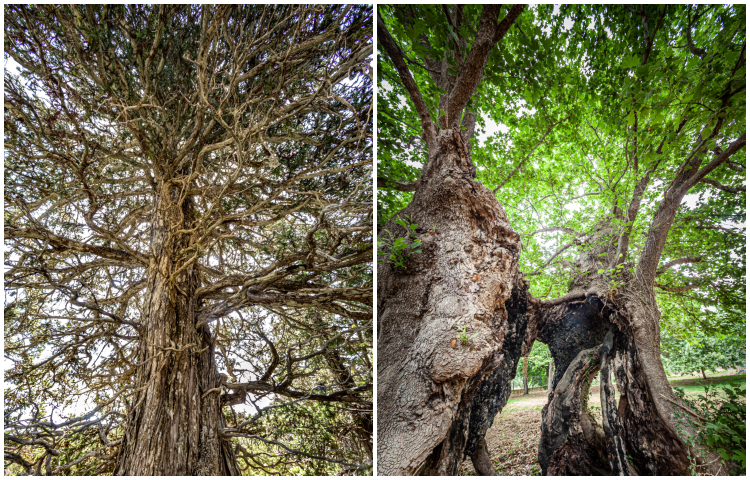
As the land rises into the hills, you pass over darker and more irregular carob and fig trees, mingling with the occasional oak and chestnut in cooler elevations, as well as strawberry trees and myrtles, their fruits and flowers adding subtle bursts of color to the green. Streams cut through the valleys in shiny ribbons, and in some hidden hollows, waterfalls tumble over rocks into clear pools. Around the banks, plane trees fan out their massive hands over the water, creating cool green tunnels and caves where the light flickers and dances.
While many may associate Greece with a mainly arid landscape, trees and plants define Peloponnese. In “Centuries-Old Trees Speak,” a story put together by Captain Vassilis & Carmen Constantakopoulos Foundation’s Morias 21 initiative, as part of the celebrations for the 200 years since the beginning of the Greek War of Independence, the ancient trees of Messinia and wider Peloponnese are given a voice, sharing their perspective on the human history that has unfolded beneath their branches. These trees, some over a thousand years old, serve as both witnesses and participants in the region’s history. Olive and plane trees have “seen” the rise and fall of empires, the sweep of revolutions, and the rhythms of everyday rural life. Their imagined voices speak of incursions, secret revolutionary meetings, and the quiet toil of generations of farmers.
The narrative of the story, which was recently included in Google Arts and Culture’s newly presented project dedicated to trees, World Wide Wood, is enriched by imagery, sound, and historical context, grounding these stories in real places: hillsides where resistance fighters once gathered, and groves where myths and memory intertwine.
But there is more than history carved into the bark and whispered through the rustling of leaves in Messinia. At Costa Navarino, the deep reverence for nature and heritage goes beyond storytelling. Being surrounded by endemic nature is an integral part of life. Over 90% of the land at the destination’s four resorts remains untouched and thriving, alive with more than 1.2 million endemic plants.
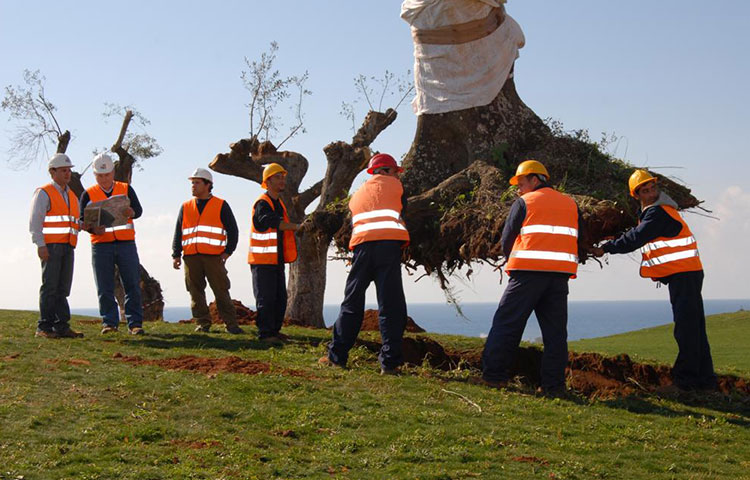
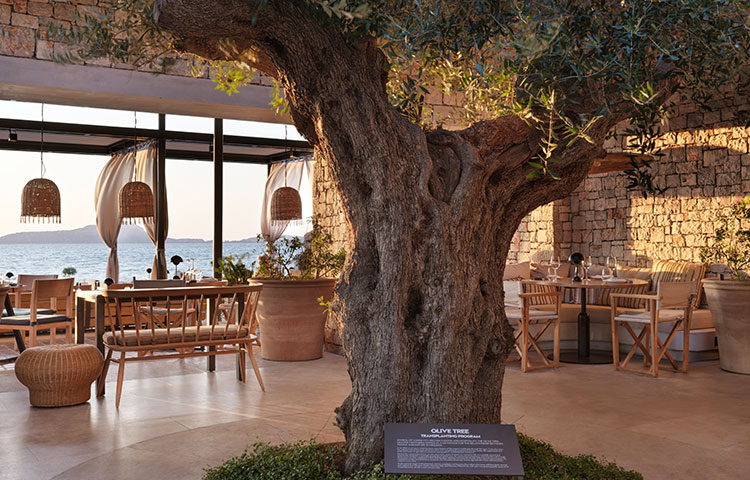
Perhaps the most profound symbol of Costa Navarino’s commitment to preserving this landscape is their olive tree transplanting program, one of the largest of its kind in Europe. During construction, over 7,000 olive trees – some of them centuries old – were gently uprooted and carefully tended under the watchful eyes of arborists and environmental experts. Later, the trees were replanted in their new homes across the resort and beyond, where they now grow as though they had never been moved. Their roots have found new depth in familiar soil, and they stand today as living monuments to continuity, memory, and care.
The olive trees, cultivated in Messinia for thousands of years, are deeply intertwined with the region’s identity and way of life. At the resorts, you see them everywhere, integrated into gardens, courtyards, and walkways, their sculptural forms are celebrated, never hidden. At W Costa Navarino’s beachfront restaurant Parelia, one such olive tree rises through the structure itself, piercing the architecture like a natural sculpture – an elemental reminder that here, buildings adapt to nature, not the other way around.